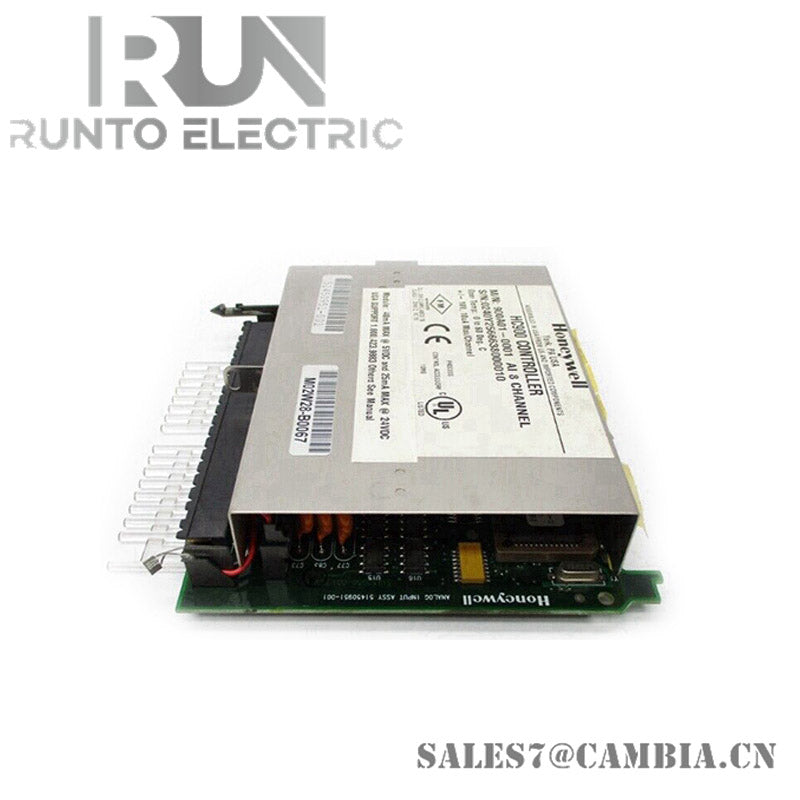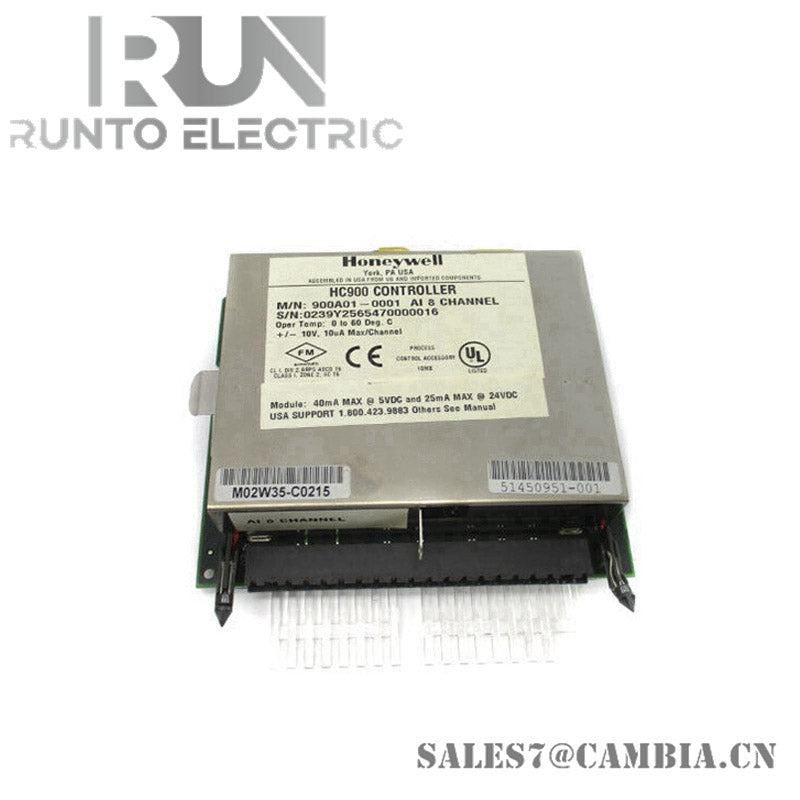
900U02-0100 | Honeywell | ControlEdge HC900 IO Modules

Honeywell 900U02-0100 ControlEdge HC900 IO Modules
The Honeywell 900U02-0100, also cataloged as the 900U02-0100 SIL UIO module, serves as the primary current‑input hardware used to execute monitored 4‑20 mA acquisition across ControlEdge HC900 platforms.
Hardware Specifications
| Parameter | Specification |
|---|---|
| Model | 900U02-0100 |
| Brand | Honeywell |
| Origin | Not specified |
| Weight | 2 kg (shipping) |
| Dimensions | Not specified |
| Operating Temp | Not specified |
| Power Consumption | Not specified |
| Input Type | Current, 2‑wire / 3‑wire / 4‑wire devices |
| Input Channels | 16 channels (line‑monitored) |
| A/D Resolution | 16 bit |
| Input Range | 4‑20 mA |
| Item Type | SIL UIO |
| Product Family | ControlEdge HC900 IO Modules |
4-20 mA HART Loop Protocol & Channel Isolation
Within Honeywell’s HC900 process‑control architecture, the module maintains deterministic 4‑20 mA loop behavior through channel‑to‑channel isolation and monitored current paths. Each channel’s line‑monitoring circuit supervises loop continuity, enabling detection of open‑circuit or wiring faults without disturbing adjacent channels. Isolation reduces noise coupling from mixed wiring bundles and preserves stable analog conversion for downstream logic execution.
Frequently Asked Questions
Q: Does the module support hot‑swap insertion? A: HC900 I/O bases generally require a safe‑state condition before removal. While mechanical insertion is possible, live replacement risks loss of monitored loop data and is not recommended.
Q: How does line monitoring affect loop behavior? A: The module injects supervisory checks to detect open circuits. These checks do not alter the 4‑20 mA signal but allow the controller to flag wiring faults.
Q: Is firmware required for the A/D converter? A: The 16‑bit converter is hardware‑based. Compatibility depends on the HC900 controller firmware, not on the module itself.
Field Installation Guidelines
Maintain shielded cable grounding at a single termination point to avoid circulating currents. Route analog wiring separately from high‑voltage conductors. Ensure proper polarity for 2‑wire, 3‑wire, and 4‑wire devices. Verify loop integrity using a calibrated milliamp source before commissioning. Avoid overtightening terminal screws to prevent conductor deformation.
900U02-0100 | Honeywell | ControlEdge HC900 IO Modules